TRANTER QCD-016-H-5-UP-113 Plate Heat Exchanger Steel 38X52X16
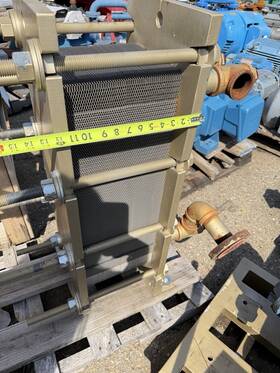
( Brand: Tranter ), ( Manufacturer Part Number: QCD-016-H-5-UP-113 ), ( Type: Plate Heat Exchanger ), ( Item Height: 38 In ), ( Color: Beige ), ( Material: Steel ), ( Year Manufactured: 2009 ), ( Item Depth: 16 In ), ( Item Width: 52 In )
Review TRANTER Plate Heat Exchanger Steel Beige 38x52x16 In
The **Tranter QCD-016-H-5-UP-113 Plate Heat Exchanger**, constructed from high-quality stainless steel, represents a robust and efficient solution for industrial heat transfer applications requiring precision, durability, and compact design. This unit falls under Tranter s **QCD series**, renowned for its **gasketed plate-and-frame heat exchanger** technology, which maximizes heat exchange efficiency while minimizing footprint and operational costs. With **dimensions of 38 inches in width, 52 inches in height, and a depth of 16 inches**, this model is engineered to fit seamlessly into tight spaces commonly found in manufacturing plants, food processing facilities, HVAC systems, or chemical processing environments where space optimization is critical.
The **QCD-016-H-5-UP-113** features a **5-pass configuration**, meaning the heat transfer plates are arranged in a way that allows the fluid to traverse five distinct channels before exiting, significantly enhancing the **temperature approach** the difference between the hot and cold fluid temperatures at the outlet and improving overall thermal efficiency. This design is particularly advantageous in applications where **high heat recovery rates** are essential, such as in **waste heat recovery systems, refrigeration circuits, or preheating processes** in industrial water heating. The **gasketed plate-and-frame construction** ensures flexibility in handling a wide range of fluids, including **water, glycol mixtures, oils, and mild chemicals**, while the **stainless steel plates** (likely **304 or 316-grade**, depending on the specific application requirements) provide superior corrosion resistance, extending the exchanger s lifespan even in harsh or corrosive environments.
One of the standout features of this unit is its **modular and scalable design**, allowing for easy maintenance and cleaning. The **plate-and-frame assembly** can be disassembled quickly to access individual plates for inspection, cleaning, or replacement, reducing downtime and maintenance costs. The **UP-113 designation** suggests a **customized plate pattern** optimized for the specific thermal performance requirements of the application, ensuring minimal pressure drop while maintaining high heat transfer coefficients. Additionally, the **corrugated plate design** increases turbulence within the fluid channels, further enhancing heat transfer efficiency without compromising flow rates.
Safety and reliability are prioritized in this heat exchanger, with **high-pressure and temperature ratings** that make it suitable for demanding industrial applications. The **gasket material** (likely EPDM, NBR, or Viton, depending on the fluid compatibility) is engineered to withstand thermal cycling and chemical exposure, preventing leaks and ensuring consistent performance over extended periods. The **compact yet sturdy frame** is built to handle **moderate to high flow rates**, making it ideal for applications where space constraints do not allow for larger, traditional shell-and-tube exchangers.
Whether integrated into a **food and beverage production line** for pasteurization, a **pharmaceutical facility** for sterile fluid heating, or an **HVAC system** for energy-efficient temperature regulation, the **Tranter QCD-016-H-5-UP-113** delivers **superior thermal performance with minimal energy loss**. Its **efficient heat recovery capabilities**, **durable construction**, and **ease of maintenance** make it a versatile and cost-effective choice for industries seeking to optimize energy use while maintaining operational reliability. With proper installation and routine upkeep, this heat exchanger stands as a dependable asset for enhancing process efficiency in a wide array of industrial settings.
### **Pros and Cons of buying a Tranter QCD-016-H-5-UP-113 Plate Heat Exchanger (Steel, 38x52x16)**
#### **Pros:**1. **High Efficiency** Plate heat exchangers (PHEs) like this one offer superior heat transfer efficiency compared to shell-and-tube designs due to their large surface area and turbulent flow channels. This leads to faster heating or cooling processes, reducing energy consumption.
2. **Compact Design** The compact footprint of plate heat exchangers allows for space-saving installations, which is particularly advantageous in facilities with limited space.
3. **Versatility** This model is suitable for a wide range of applications, including HVAC systems, industrial process heating/cooling, food and beverage processing, and chemical processing. The stainless steel construction ensures compatibility with corrosive fluids.
4. **Modularity** The unit appears to be part of a series that allows for easy expansion or modification by adding more plates or adjusting configurations, making it adaptable to changing process requirements.
5. **Low Maintenance** Compared to shell-and-tube exchangers, plate heat exchangers have fewer components, reducing the risk of leaks and simplifying maintenance tasks like cleaning and plate replacement.
6. **Energy Savings** The efficient heat transfer minimizes the need for excessive energy input, leading to lower operational costs over time.
7. **Corrosion Resistance** The stainless steel construction (likely 316 or similar grade) provides excellent resistance to corrosion, extending the lifespan of the unit in harsh environments.
8. **Quick Response Time** Plate heat exchangers can rapidly adjust to temperature changes, making them ideal for applications requiring precise temperature control.
---
#### **Cons:**1. **Pressure Limitations** Plate heat exchangers generally have lower pressure ratings compared to shell-and-tube exchangers. If your application involves high-pressure fluids, this model may not be suitable without additional reinforcement or a different design.
2. **Fouling Susceptibility** While plate heat exchangers are easy to clean, certain fluids (e.g., those with suspended solids or viscous materials) can foul the plates more quickly than larger channels in shell-and-tube designs. Regular maintenance may be required.
3. **Cost of Replacement Plates** If plates become damaged or worn out, replacement plates can be expensive, especially if they are custom-fitted or require specialized materials.
4. **Limited Temperature Range** Some plate heat exchangers have temperature limitations (e.g., maximum operating temperatures around 200 250 C, depending on the material). If your application involves extremely high or low temperatures, this model may not be ideal.
5. **Potential for Leaks** The gasket seals in plate heat exchangers can wear out over time, leading to leaks if not inspected regularly. This requires vigilant maintenance to avoid downtime.
6. **Higher Initial Cost** While plate heat exchangers often save money in the long run due to efficiency, the upfront cost can be higher than that of a basic shell-and-tube exchanger, particularly for large or customized units.
7. **Installation Complexity** Improper installation (e.g., misalignment of plates or incorrect gasket placement) can lead to performance issues or leaks. Professional installation is recommended.
8. **Not Ideal for Highly Abrasive Fluids** While stainless steel is durable, abrasive particles in the fluid can accelerate wear on the plates, reducing the unit s lifespan.
---
### **Conclusion:**The **Tranter QCD-016-H-5-UP-113 plate heat exchanger** is an excellent choice for applications requiring **high efficiency, compactness, and energy savings**, particularly in industries like HVAC, food processing, or chemical manufacturing where space and performance are critical. Its stainless steel construction ensures durability and corrosion resistance, making it suitable for a broad range of fluids.
However, if your application involves **high pressure, extreme temperatures, or highly abrasive/viscous fluids**, you may need to consider alternatives such as reinforced plate designs, shell-and-tube exchangers, or additional pretreatment systems to mitigate potential drawbacks. Regular maintenance will also be essential to prevent fouling and leaks.
### **Recommendation:** - **Buy this unit if:**- You need a **high-performance, space-efficient** heat exchanger for moderate to low-pressure applications.
- Your fluids are **non-abrasive and not excessively viscous**, and you can commit to regular cleaning and maintenance.
- You prioritize **energy savings and rapid temperature control** over absolute pressure or temperature limits.
- **Consider alternatives if:**- Your process requires **high-pressure or extreme temperature handling** (e.g., above 250 C or 400 psi).
- The fluids are **highly abrasive, corrosive, or prone to rapid fouling**, which could shorten the exchanger s lifespan.
- You prefer a **lower initial cost** and are willing to accept slightly lower efficiency for simpler maintenance.
For most **standard industrial or commercial applications**, this Tranter plate heat exchanger is a **strong, cost-effective choice** when properly sized and maintained. If in doubt, consult with a thermal fluid specialist to confirm compatibility with your specific process parameters.
Details:
FOR SHIPPING AND DISCOUNT MESSAGE DIRECTLY OR 248 222 0084.
part #: qcd016h5up113 price
- $3500.00
specifications indheatexchanger:
- brand: Tranter
- mpn: Qcd-016-h-5-up-113
- type: Plate Heat Exchanger
- item height: 38 In
- color: Beige
- material: Steel
- year manufactured: 2009
- item depth: 16 In
- item width: 52 In
payments indheatexchanger:
- credit card: Visa
- other
- wallet: Paypal
offer indheatexchanger:
- availability: In Stock
- quantity: 1
- sold: 0
- started: April 20, 2026
- options: Seller-arranged-local-pickup
shipping indheatexchanger:
returns indheatexchanger:
- policy: No Returns
seller indheatexchanger:
- city: Walled Lake, Michigan
- # reviews: 0
- rating: 0.0%
general indheatexchanger:
- HVAC Refrigeration > HVAC Refrigeration Components > Heat Exchangers
- condition: Used
Tranter QCD-016-H-5-UP-113 Is Similar To:
- Tranter S3-hj-32 Superchanger Heat Exchanger 67.6 Sq Ft (50.8% similar) Tranter supercharger S3-HJ-32 heat exchanger...(December 18th, 2023)
- Tranter S3-hp-32 Superchanger Heat Exchanger 101.4 Sq Ft (52% similar) Tranter supercharger S3-HP-32 heat exchanger...(December 25th, 2023)
- Tranter Uxp-005-m-8-sj-73 Superchanger Plate And Frame Heat Exchanger 500 Ship By Freight Obo (49.4% similar) With its high-quality plastic material and advanced plate design, it can handle various applications. The listing price is open for negotiation, so feel free to make an offer that suits your budget. The model number, UXP-005-M-8-SJ-73, ensures that you are getting the exact unit need. This Tranter ...(January 17th, 2024)
- Tranter Ux-296-hp-137 Superchanger Plate Heat Exchanger With Positioner 712dk (55% similar) ...(January 21st, 2024)
- Tranter Ux-216-hp-137 Superchanger Plate Heat Exchanger With Positioner 711dk (56.4% similar) ...(January 22nd, 2024)
- Tranter S3-hp-42 Superchanger Heat Exchanger 135.2 Sq Ft (50.4% similar) Powder coating, liquid coating and electrocuting. Shipping charges to be paid by buyer for all. Rates, product handling, energy efficiency, floor space, and budgets in order. Systems to a large variety of companies throughout the northern hemisphere. Information on this item or would like to inquire...(April 26th, 2024)
- Tranter S3-hj-22 Superchanger Heat Exchanger 67.6 Sq Ft (50.8% similar) Systems, refurbished systems, removal, relocation and upgrading services for. Powder coating, liquid coating and electrocuting. Shipping charges to be paid by buyer for all. Next day and second. Information on this item or would like to inquire about any other equipment. Rates, product handling, ...(April 26th, 2024)
- Tranter Ux-416-up-419 3411.3 Sq Ft Superchanger Heat Exchanger (53.7% similar) S/n: SC-5906. Year built: 1991 . Plate pack dimensions: minimum - 65.98 / maximum 69.28. Tranter supercharger large heat exchanger. Model #: UX-416-UP-419...(July 30th, 2024)
- Tranter Gxd-026 Plate And Gasket For Heat Exchanger 37 Inch X 15 (56.3% similar) Tranter GXD-026 plate and gasket for heat exchanger 37 x 15. Shipped with FedEx ground or home delivery. Condition is new...(October 2nd, 2024)
- Tranter Ux-226hp-60 Superchanger Plate Heat Exchanger Display 6 Inch Tall 3 Wide (54.3% similar) The model number is UX-226HP-60 and it designed to fit units of ft. The item depth is 6 inches, making it a convenient choice for your setup. This Tranter supercharger plate heat exchanger display is a great addition to your hvac and refrigeration system...(October 20th, 2024)
- Tranter 65324-ansi Heat Exchanger 48 Inch Pipe Heater Chiller Steel Transfer Plate Set (47.1% similar) Country of manufacture/a. Selling as a set. Part NUMBER65324 ANSI. Conditioner. 1 ANSI flange. Items in LOT1. Could clamp onto a 48 pipe or tub. And the cost of return shipping. Ask our experts...(December 27th, 2024)