FLATPLATE FP5X12-14 Plate Thread Gpm Heat Exchanger 131002772 3/4
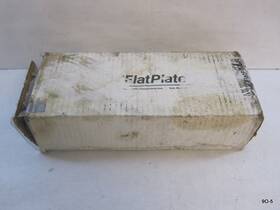
( Brand: Flatplate ), ( Manufacturer Part Number: FP5X12-14 ), ( Model: 131002772 ), ( Material: 99.9 Copper, Stainless Steel 316l ), ( Type: Hydronic Heat Exchanger )
Review FLATPLATE Plate 3/4 Inch Thread Gpm Heat Exchanger
The **Flat Plate Heat Exchanger (FP5X12-14, 14 Plates, 3/4" Thread, 20 GPM)** is a high-performance, compact thermal transfer system designed for efficient heat exchange in industrial, commercial, and HVAC applications. Engineered with precision, this heat exchanger features a **14-plate configuration** arranged in a **5x1X2 plate pattern**, optimizing flow distribution and maximizing heat transfer efficiency while minimizing pressure drop. The **3/4-inch threaded ports** ensure secure and leak-proof connections, accommodating standard piping systems for both hot and cold fluids, making it ideal for applications such as chilled water systems, solar thermal setups, geothermal heat pumps, and process cooling. With a **rated capacity of 20 gallons per minute (GPM)**, this unit delivers reliable thermal performance, efficiently transferring heat between two separate fluid streams without mixing, ensuring energy savings and operational efficiency. Constructed from **high-grade stainless steel plates**, typically 316 or 304 grade, the heat exchanger resists corrosion, scaling, and chemical degradation, extending its lifespan in demanding environments. The **gasket-sealed plates** provide a tight seal, preventing cross-contamination while allowing for easy disassembly and cleaning, reducing maintenance downtime. Its **compact footprint** makes it space-efficient, suitable for installations where real estate is limited, while its **modular design** allows for easy expansion or replacement of individual plates if needed. Whether integrated into a refrigeration cycle, a solar water heating system, or an industrial process cooling loop, this heat exchanger delivers consistent thermal performance, durability, and cost-effective operation, making it a versatile choice for engineers and facility managers seeking both reliability and efficiency.
**Pros and Cons of Buying a Flat Plate Heat Exchanger (FP5X12-14, 14 Plates, 3/4" Thread, 20 GPM)**
### **Pros**
1. **Efficiency and Compact Design** Flat plate heat exchangers are known for their high heat transfer efficiency due to their large surface area relative to size. This model s 14-plate configuration maximizes heat exchange while occupying minimal space, making it ideal for applications where footprint is a concern.
2. **Versatility in Applications** The 20 GPM (gallons per minute) flow rate suggests it is suitable for moderate to high-flow systems, such as HVAC, industrial process cooling, solar thermal systems, or even some refrigeration applications. The 3/4" threaded connections ensure compatibility with standard piping systems.
3. **Modularity and Scalability** Flat plate heat exchangers can be easily expanded by adding more plates or units in series/parallel, allowing for future upgrades without replacing the entire system. This modularity makes them cost-effective for growing operations.
4. **Low Maintenance Requirements** Compared to shell-and-tube exchangers, flat plate models typically require less maintenance. Plates can be cleaned or replaced individually if fouling occurs, reducing downtime.
5. **Energy Savings** Their efficient heat transfer reduces energy consumption by minimizing temperature differentials between fluids, leading to lower operational costs over time.
6. **Corrosion Resistance (if properly selected)** Stainless steel plates (common in many FP models) resist corrosion better than some other materials, extending the unit s lifespan in harsh environments.
7. **Quick Installation** The compact design and straightforward threading simplify installation, reducing labor costs and setup time compared to bulkier alternatives.
---
### **Cons**
1. **Pressure Limitations** Flat plate heat exchangers generally have lower pressure ratings compared to shell-and-tube designs. The FP5X12-14 model may not be suitable for high-pressure applications (e.g., steam systems or extreme industrial processes) without reinforcement or customization.
2. **Fouling Susceptibility** While plates can be cleaned, certain fluids (e.g., those with suspended solids or high viscosity) can clog the channels over time, requiring frequent maintenance. This may not be ideal for dirty or abrasive liquids without pre-filtration.
3. **Temperature Constraints** Most flat plate exchangers have temperature limits (often below 200 C/400 F for standard models). If your application involves extremely high or low temperatures, a different design (e.g., brazed plates or shell-and-tube) may be necessary.
4. **Leak Risk** The gasket-sealed plates can leak if improperly installed, over-torqued, or if gaskets degrade over time. Regular inspections are required to prevent failures.
5. **Cost of Replacement Plates** While individual plates are replaceable, the cost of spare plates or gaskets can add up, especially for specialized materials (e.g., titanium or high-grade stainless steel).
6. **Limited Customization** Unlike shell-and-tube exchangers, flat plate models offer fewer options for customizing plate patterns, materials, or configurations for niche applications. Standardization may restrict flexibility in some cases.
7. **Space for Large Systems** While compact, very high-capacity systems may require multiple units, which could offset some of the space-saving benefits.
8. **Potential for Plate Warping** Over time, thermal cycling or mechanical stress can cause plates to warp, reducing efficiency. This is less common in well-designed units but is a consideration for long-term use.
---
### **Ending Conclusion**
The **FP5X12-14 (14 plates, 3/4" thread, 20 GPM)** flat plate heat exchanger is a **strong choice for applications requiring efficient, space-saving heat transfer** in moderate to high-flow systems (e.g., HVAC, solar thermal, or industrial cooling). Its **modularity, low maintenance, and energy efficiency** make it cost-effective for many scenarios. However, it may **not be ideal for high-pressure, high-temperature, or fouling-prone applications** without additional precautions (e.g., pre-filtration, custom materials, or reinforcement).
If your system operates within the **pressure, temperature, and flow rate limits** of this model and involves **clean or moderately clean fluids**, this heat exchanger offers a **good balance of performance and affordability**. For **extreme conditions or large-scale industrial use**, a shell-and-tube or plate-and-frame exchanger with heavier duty construction may be more appropriate.
---
### **Recommendation**
**Buy this heat exchanger if:**- Your application involves **moderate flow rates (20 GPM)** and **moderate pressures/temperatures**.
- You prioritize **space efficiency, energy savings, and ease of maintenance**.
- The fluids are **not excessively dirty or abrasive** (or you can pre-filter them).
- You may need **future scalability** (e.g., adding more plates or units).
**Consider alternatives if:**- Your system requires **high pressure, extreme temperatures, or aggressive fluids**.
- **Fouling is a major concern** without pre-treatment.
- You need **customized plate configurations** or **long-term high-reliability guarantees**.
**Additional Tips:**- Verify compatibility with your **specific fluids and operating conditions** (e.g., pH, viscosity).
- Check the manufacturer s **warranty and support** for replacement parts.
- If possible, **test a sample plate** for fouling resistance if dealing with unknown fluids.
- For **long-term use**, budget for **gasket and plate replacements** as needed.
This unit is a **solid mid-range option** for many practical applications, but always cross-validate its specs with your exact requirements.
Details:
Item has never been used, but is old and discontinued. Please look at ALL the pictures. No other parts, hardware, accessories or packaging included. I try to match CURRENT cheaper price I don'match past prices.
part #: fp5x1214 price
- $1182.99
specifications indheatexchanger:
- brand: Flatplate
- mpn: Fp5x12-14
- model: 131002772
- material: 99.9 Copper, Stainless Steel 316l
- type: Hydronic Heat Exchanger
general indheatexchanger:
- HVAC Refrigeration > HVAC Refrigeration Components > Heat Exchangers
- condition: Used
payments indheatexchanger:
- credit card: Visa
- other
- wallet: Google-pay
returns indheatexchanger:
- policy: Returns Accepted
- method: Money back
- paid by: Seller
- time: 30 Days
seller indheatexchanger:
- # reviews: 14949
- rating: 99.3%
- city: Athens, Georgia
offer indheatexchanger:
- options: Ship-to-home
- started: February 13, 2026
- sold: 0
- availability: In Stock
- quantity: 1
shipping indheatexchanger:
- type: Fixed
- service: Economy, USPS Priority Mail, UPS Next Day Air Saver
- class: Economy, Expedited, One-day
- transit: 5-10 Days
- carrier: USPS, UPS
- cost: $0.00
Flatplate FP5X12-14 Is Similar To:
- Flatplate Dw10x20-10 Heat Exchanger Model Used Great Condition (45.9% similar) Flatplate heat exchanger DW10X20-10 used happy buying...(November 25th, 2023)
- Flatplate Fp5x12-90 S8 P10 Heat Exchanger 5 Inch X12 90 Plates 1200 Maximum Btus (53.6% similar) Condition: used. The photos show the exact item buyer will receive. Model: FP5X12-90 S8, S8, P10. Buyer pays for all shipping costs. Totally sealed stainless steel construction. Specifications. 5 x 12 90 plates. Comes in non-original packaging. Antler-looking pipes on one end. Flatplate FP5X12-90 s8...(December 18th, 2023)
- Flatplate Fp3x8-24 3p 6973 131007129 Heat Exchanger T209659 (54.5% similar) F c 350 177 vol. Psi bar 450 31.0 max. Flatplate FP3X8-24/3P/6973 131007129 heat exchanger T209659 warranty information: this is a used item, in good condition and includes 30 day warranty.: max...(January 3rd, 2024)
- Flatplate Fp5x12-36 7 8 Inch Sweat Heat Exchanger 450-psi 350 F Vola 043ft3 (61.7% similar) This item is guaranteed to be as described. It has scuffs and scratches from normal use. Model: FP5X12-36 7/8 sweat. Manufacturer: Flatplate. The photos show the exact item buyer will receive. Specifications. Physical size: 12 l x 5 w 3.5WITHOUT ports. Condition: used. This item comes in non-...(January 9th, 2024)
- Flatplate Br5x12-6 Flat Plate Heat Exchanger Model (61.8% similar) Used but in good condition. Has two watts ESP 125 strainers attached. Flat plate heat exchanger model BR5X12-6...(May 1st, 2024)
- Flatplate Fp5x12-50 Preowned 1-1 4 Inch Mpt 50 Plate Heat Exchanger Warranty (64.4% similar) 30 day hassle free warranty. Local pick-up is always an option. No warranty on untested/parts listings. Fast and flexible shipping. Fast shipped with ups. Preowned flushed - in factory box Flatplate FP5X12-50 1-1/4 mot 50 plate heat exchanger warranty. Why j j industrial supply. Handled with care ...(May 17th, 2025)
- Flateplate Ch33a Flatplate Chiller Heat Exchanger Model 1in Mpt 300 Psi 350 F (40% similar) Some cosmetic rust and dirt due to age storage. Made in York, pa, USA. Design pressure: 300 pig both sides. Model: CH33A 1IN mot. Design temperature: 350. Condition: used, untested. Volume: 0.035 / 0.038 cruft. Type: chiller / heat exchanger. See photos for actual item condition...(June 14th, 2025)
- Flatplate Ch3a 3 4 Mpt Ns-xp Gea Heat Exchanger Flat Plate 3 Ton (53.2% similar) The CH3A - 3/4 mot NS-PX Gaea heat exchanger flat plate 3 ton is a multi-positional plate heat exchanger designed for indoor/outdoor use. Manufactured in 2016 by the brand Flatplate, this 3-3.9 tons system boasts an energy efficiency ratio e'er of 3 or less and a seer rating 30. With a power ...(June 17th, 2025)
- Flatplate Fp5x12-40 Gea Heat Exchanger 1 Inch Mpt mmc Used Surplus (54.3% similar) If you do not see it in the pictures then most likely doesn come way as with item. Location: mike pallet. Please feel free to ask question before purchase if you are unclear of a certain detail. Please see pictures carefully for further visual details as they are part of the...(November 14th, 2025)