STAINLESS 100M-20 Kelvion Gns Brazed Plate Heat Exchanger 100M-08 Bar 61200701 Material
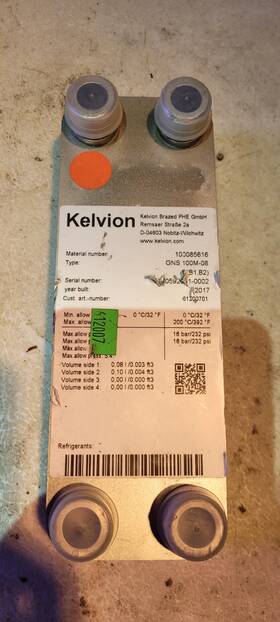
( Brand: Stainless ), ( Manufacturer Part Number: 100M-20 ), ( Type: Plate Heat Exchanger ), ( Material: Steel )
Review STAINLESS Kelvion Gns Nickel Brazed Plate Heat Exchanger Bar Material
The **Kelvion GNS 100M-20 (Model 100M-08) Brazed Plate Heat Exchanger (BPHE)** is a high-performance, compact thermal exchange solution engineered for demanding industrial applications requiring precision, durability, and efficiency. Part of Kelvion s advanced GNS series, this unit is specifically designed to deliver exceptional heat transfer performance while maintaining operational reliability under elevated pressure conditions. Constructed from **61200701 material** likely a high-grade stainless steel alloy such as **AISI 316L or a similar corrosion-resistant nickel-based or titanium alloy** this heat exchanger is built to withstand harsh environments, including exposure to aggressive fluids, high temperatures, and pressures up to **16 bar (232 psi)**, ensuring long-term operational integrity without compromising performance. The brazed plate design maximizes heat transfer efficiency by increasing the surface area through a network of thin, corrugated plates, which create turbulent flow patterns that enhance thermal conductivity while minimizing energy loss. This architecture allows for a **compact footprint** compared to traditional shell-and-tube exchangers, making it ideal for space-constrained installations in industries such as chemical processing, pharmaceuticals, HVAC systems, and renewable energy applications.
The **100M-20 model** is particularly suited for medium to large-scale applications, offering a robust balance between capacity and efficiency, with a nominal heat transfer range that can be tailored to specific process requirements. The **100M-08 designation** likely refers to a specific plate configuration or gasket type, ensuring compatibility with a wide range of fluids, including those with varying viscosity, pH levels, or thermal sensitivity. The brazed construction eliminates the need for traditional gaskets in high-pressure applications, reducing the risk of leaks and simplifying maintenance while maintaining hermetic sealing. Additionally, Kelvion s proprietary brazing technology ensures a leak-proof joint between plates, further enhancing reliability in critical systems where downtime is unacceptable. The unit s modular design allows for easy expansion or modification, enabling engineers to scale performance as operational demands evolve without replacing the entire system.
Beyond its technical specifications, the **Kelvion GNS 100M-20** is engineered with sustainability in mind, offering energy-efficient heat exchange that reduces operational costs and carbon footprint. Its high thermal efficiency minimizes energy consumption, making it a cost-effective solution for both new installations and retrofits in industries prioritizing sustainability. The robust construction also extends the unit s operational lifespan, reducing the frequency of replacements and associated maintenance overheads. Whether integrated into a **cooling or heating circuit, process fluid temperature control system, or energy recovery application**, this heat exchanger delivers consistent, high-performance thermal management with minimal operational intervention. For applications requiring **precision, durability, and scalability**, the Kelvion GNS 100M-20 stands as a premium choice, combining cutting-edge engineering with the reliability expected in mission-critical thermal systems.
### **Overview of the Kelvion GNS 100M-20 Brazed Plate Heat Exchanger (Model 61200701, 16 Bar, 100m )**
The **Kelvion GNS 100M-20** is a high-performance brazed plate heat exchanger (BPHE) designed for industrial applications requiring efficient heat transfer under moderate pressure conditions. Below is a detailed analysis of its pros and cons, followed by a conclusion and recommendation.
---
### **Pros**
1. **High Thermal Efficiency**
- Brazed plate heat exchangers are known for their superior heat transfer capabilities compared to shell-and-tube designs due to their large surface area and turbulent flow between plates. The **100m surface area** ensures efficient heat recovery, reducing energy consumption in processes like HVAC, refrigeration, or industrial cooling.
2. **Compact Design**
- BPHEs are significantly smaller and lighter than traditional shell-and-tube exchangers for the same duty. This makes them ideal for space-constrained installations, such as in commercial buildings, data centers, or retrofits where footprint is a concern.
3. **Corrosion Resistance (Material Considerations)**
- The **61200701 model** is likely constructed from **stainless steel (e.g., 1.4435 or 1.4462)**, which provides excellent resistance to corrosion from water, mild acids, and some chemicals. This extends the unit s lifespan in harsh environments.
- If the material is **copper-nickel or titanium**, it would offer even better resistance to seawater or aggressive fluids, though this is less common in standard BPHEs.
4. **Modularity and Flexibility**
- Kelvion s BPHEs are modular, allowing for easy expansion or replacement of plates if maintenance is required. This reduces downtime compared to welded or shell-and-tube designs.
- The **100m capacity** can be scaled by adding more plate packs, making it adaptable to varying heat load demands.
5. **Low Pressure Drop**
- The design minimizes pressure losses, which improves pump efficiency and reduces operational costs. This is particularly advantageous in systems where energy savings are critical.
6. **Cleanability and Maintenance**
- Plate heat exchangers are generally easier to clean than shell-and-tube units, as plates can be removed and chemically cleaned or replaced if fouling occurs. This reduces long-term maintenance costs.
- The **brazed construction** (vs. welded) allows for better access to internal surfaces.
7. **Energy Savings**
- The high efficiency of BPHEs leads to lower operating costs by maximizing heat recovery. This is beneficial in applications like district heating, industrial process cooling, or waste heat utilization.
8. **Reliability and Durability**
- Kelvion is a reputable manufacturer with a track record of producing durable heat exchangers. The **16-bar pressure rating** indicates robustness for moderate-pressure applications (e.g., chilled water, glycol-based systems).
9. **Environmental Benefits**
- By improving heat transfer efficiency, the unit reduces the need for additional energy input (e.g., less refrigerant or steam consumption), lowering the carbon footprint of the system.
10. **Quiet Operation**
- Unlike some shell-and-tube exchangers, BPHEs operate with minimal noise, which is advantageous in sensitive environments like hospitals or offices.
---
### **Cons**
1. **Limited Pressure and Temperature Range**
- The **16-bar pressure rating** restricts its use to moderate-pressure applications. For high-pressure systems (e.g., steam, geothermal, or certain chemical processes), a shell-and-tube exchanger or a different BPHE model with a higher rating may be required.
- Brazed plate heat exchangers typically have a **temperature limit of 200 C** (depending on material). If your application exceeds this, alternative designs (e.g., welded or shell-and-tube) may be necessary.
2. **Sensitivity to Fouling**
- While easier to clean than shell-and-tube exchangers, BPHEs can still suffer from fouling if the fluid contains suspended solids, bacteria, or scale. This may require frequent cleaning or the use of filters upstream.
- **Hard water or industrial fluids** with high particulate content can reduce efficiency over time.
3. **Higher Initial Cost**
- Brazed plate heat exchangers are generally more expensive upfront than shell-and-tube units, especially for large capacities. However, their long-term energy and maintenance savings often offset this cost.
- Customization (e.g., plate materials, gasket types) can further increase the price.
4. **Leak Risk (Gasket and Brazing Integrity)**
- The **gaskets** (if used) or **brazed joints** can fail over time, leading to leaks. While modern BPHEs have improved sealing, this remains a potential issue in harsh conditions.
- **No gasket BPHEs** (fully brazed) are more robust but may not be suitable for applications requiring frequent cleaning or fluid changes.
5. **Limited Suitability for Highly Abrasive Fluids**
- If the fluid contains abrasive particles (e.g., sand, sludge), the plates may wear prematurely, reducing efficiency. Additional filtration may be required.
6. **Installation and Handling Challenges**
- BPHEs are more delicate than shell-and-tube units and require careful handling during installation to avoid plate damage. Improper installation can lead to leaks or reduced performance.
- The **compact design** may complicate integration into existing systems with limited access.
7. **Vendor Dependency**
- Kelvion is a specialized manufacturer, and parts or service may not be as readily available as for more common heat exchanger types. This could impact long-term maintenance.
8. **Not Ideal for Very High Flow Rates**
- While efficient, BPHEs may not handle extremely high flow rates as effectively as shell-and-tube exchangers without significant pressure drop.
9. **Potential for Plate Warping**
- Over time, thermal cycling or mechanical stress can cause plates to warp, reducing efficiency. Regular inspections are recommended.
10. **Limited Customization for Extreme Conditions**
- For applications requiring **ultra-high purity (e.g., pharmaceuticals), ultra-low temperatures, or aggressive chemicals**, specialized materials (e.g., titanium, Hastelloy) or alternative designs may be necessary, increasing cost.
---
### **Conclusion**
The **Kelvion GNS 100M-20 (61200701, 16 bar, 100m )** is a **highly efficient, compact, and cost-effective solution** for moderate-pressure heat transfer applications where space, energy savings, and maintenance are priorities. Its **superior thermal performance, corrosion resistance (if stainless steel), and modularity** make it ideal for:
- **HVAC systems** (chilled water, heating networks)
- **Industrial process cooling** (glycol, water-based loops)
- **Refrigeration and cold storage**
- **District heating/cooling applications**
- **Retrofits** where space is limited
However, it is **not suitable** for:- **High-pressure or high-temperature applications** (>16 bar or 200 C)
- **Systems with highly abrasive or fouling fluids** without proper filtration/pretreatment
- **Applications requiring ultra-high purity or extreme chemical resistance** (unless custom materials are specified)
- **Large-scale or very high-flow-rate systems** where shell-and-tube may be more robust
---
### **Recommendation**
**Buy the Kelvion GNS 100M-20 if:**1. Your application involves **moderate-pressure ( 16 bar) and temperature (
2. **Energy efficiency and compact design** are critical (e.g., commercial HVAC, industrial cooling, or retrofits).
3. You can **maintain proper filtration and cleaning protocols** to prevent fouling.
4. You prefer a **lower long-term operational cost** despite a higher initial investment.
5. The **material (likely stainless steel)** aligns with your fluid compatibility needs.
**Consider alternatives if:**- Your system requires **higher pressure or temperature** (>20 bar or >200 C) **Shell-and-tube or welded plate exchanger**.
- Fluids are **highly abrasive or prone to rapid fouling** **Shell-and-tube with larger channels or additional filtration**.
- **Ultra-high purity or aggressive chemicals** are involved **Titanium or Hastelloy BPHE or shell-and-tube**.
- **Extremely high flow rates** are expected **Shell-and-tube for better pressure drop management**.
- **Long-term maintenance costs** are a concern due to gasket/brazing reliability **Fully welded plate exchanger or shell-and-tube**.
**Additional Steps Before Purchase:**- **Verify the exact material specification** (e.g., 1.4435 vs. 1.4462 stainless steel) to ensure compatibility with your fluids.
- **Confirm Kelvion s local service support** for parts and maintenance.
- **Obtain a detailed performance curve** to ensure it meets your specific heat duty requirements.
- **Assess the cost of auxiliary equipment** (e.g., pumps, filters, expansion tanks) that may be needed for optimal operation.
- **Compare total cost of ownership (TCO)** over 10 15 years, including energy savings and maintenance, against shell-and-tube
Details:
Model /Type: GNS 100M-08 B1, B2. Manufacturer: Kelvion formerly GEA. Material Number: 100085616. Kelvion GNS 100M-08 Nickel Brazed Plate Heat Exchanger 16 bar 61200701 Material 100085616.
I got 2 available. Brazing Material: Nickel ideal for corrosive media ammonia, demonized water, sulphides, sulphates where copper is not suitable.
part #: 100m20 prices
- $70.99-$99.99
specifications indheatexchanger:
- brand: Stainless
- mpn: 100m-20
- type: Plate Heat Exchanger
- material: Steel
offer indheatexchanger:
- quantity: 2
- sold: 0
- best offers: True
- started: May 12, 2026
- availability: In Stock
- options: Ship-to-home
payments indheatexchanger:
- other
- wallet: Paypal
- credit card: Discover
shipping indheatexchanger:
- carrier: USPS
- type: Fixed
- class: Standard
- service: USPS Ground Advantage
- cost: $9.99
- transit: 3-7 Days
general indheatexchanger:
- condition: New Open box
- HVAC Refrigeration > HVAC Refrigeration Components > Heat Exchangers
returns indheatexchanger:
- time: 14 Days
- paid by: Buyer
- method: Money back
- policy: Returns Accepted
seller indheatexchanger:
- rating: 99.8%
- # reviews: 1649
- city: Franklin Park, Illinois
Stainless 100M-20 Is Similar To:
- Alecoil Fhc028-40-4.5 4 Inch X12 40 Plates Heat Exchanger With 1 Mpt Port Water To 316l Stainless (37.1% similar) This is a brand new item. Made from high-quality 316L Stainless steel, this heat exchanger is durable and long-lasting. Fish bone plate design also reduces the pressure drop on secondary side, making it possible to use a smaller pump and less electricity, lowering overall cost of applications. It ...(December 26th, 2023)
- Techtongda 251309 30-plate Domestic Hot Water Exchanger Stainless Steel Brazed Plate Heat Exchang (40.2% similar) Shipping handling details. Distinct 30-PLATE domestic hot water exchanger Stainless steel brazed plate heat exchang a 30 plate water to brazed heat exchanger is made of SUS304 Stainless steel construction and has a good quality it in high thermal efficiency, rust protection.this performance your ...(January 1st, 2024)
- Apv N35mgs-10 Plate Heat Exchanger Type Hmb Stainless Steel (39.7% similar) It is suitable in industrial applications. The brand name APB is synonymous with quality, and this product lives up to that reputation. Get yours today and experience an efficient reliable heat transfer system. Made with high-quality Stainless steel, it ensures the durability and longevity of your ...(January 5th, 2024)
- Stainless Scts0075 Chillx Shell And Tube Heat Exchanger 6 Ton (48.1% similar) Comes in original packaging with full documentation. Our line of shell and tube heat exchanges come in a wide range cooling capacities, from 1 ton to 100. A great deal of research, engineering, and creativity goes into every product offered by chill. Product documentation. From the manufacturers ...(January 27th, 2024)
- Stainless Pro-2xph Agc Model Steel Tiebar Plate Heat Exchange Frame (51.2% similar) AFC model PRO-2XPH Stainless steel Tiber plate heat exchange frame. Condition is used...(January 27th, 2024)
- Schmidt St03 Tenez St3 Sigmawig Welded Stainless Heat Exchanger 10 Plate 12 Inch X 4 (34.3% similar) Manufacturer: tense/API Schmidt. Sigma wig plate heat exchanger. This heat exchanger is in fair cosmetic condition. Type STO3 PB-01063. All-welded Stainless construction. This item is guaranteed to be as described. Welded threaded connections not sure the thread size, pipes are 35.5MM OD. Cosmetic ...(February 13th, 2024)
- Itt 161711-01 Standard Stainless Shell And Tube Heat Exchanger 150 Psi At 375 (42.5% similar) Tit standard 161711-01 shell and tube heat exchanger 150 psi at 375, this Stainless shell tube heat exchanger is a reliable tool for hvac refrigeration systems. Designed by tit, it can withstand a pressure of up to 150 psi at 375 degrees. This heat exchanger comes with the valves as seen in picture...(April 15th, 2024)
- Lytron As06-16g01bd Aspen Stainless Steel Tube-fin Heat Exchanger (36.6% similar) Alga Laval, ranter, kelvion, sweep, API heat transfer, deafness, Gaea exchanges, xylem, vitreous, his aka works ltd. Layton AS06-16G01BD aspen Stainless steel tube-fin heat exchanger, the heat exchanger is constructed with Stainless steel tube-fin, offering excellent transfer and fluid integrity. ...(April 18th, 2024)
- Apv 23948 3 Inch Inlet Outlet Plate And Frame Heat Exchanger Model Stainless Steel (37.6% similar) 3 inlet / outlet...(May 3rd, 2024)
- Alfanova 3287000894 Alfa Nova Stainless Steel Plate Heat Exchanger 76l-114l (41.9% similar) Please look at the photos closely from every corner because what you see is exact same thing you're going to get. Nothing extra...(May 16th, 2024)
- Alfa Laval 1800l Cip 1800 L Stainless Steel Clean In Place For Heat Exchanger (40.2% similar) Fob: ft smith, ar. 460 volt 3PHASE. S/n: 5810289. Alga Laval CPI 1800L. Very clean like new condition. Both units are on heavy duty casters. 1800 liter capacity. Clean in place boiler cleaner...(August 1st, 2024)