EXERGY 02655-10 Double Tubesheet Tube Sanitary Heat Exchanger 20.3SQFT
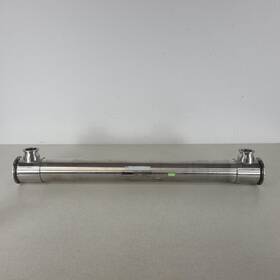
( Brand: Exergy ), ( Manufacturer Part Number: 02655-10 ), ( Type: Shell Tube Heat Exchanger ), ( Unit Type: Unit )
Review EXERGY Double Tubesheet Shell Tube Sanitary Heat Exchanger 20.3sqft
The **Exergy 02655-10 Double Tubesheet Tube Sanitary Heat Exchanger (20.3 sq ft)** is a high-performance, hygienic heat transfer solution engineered for demanding applications in the food and beverage, pharmaceutical, biotechnology, and chemical processing industries. Designed with precision and built to meet stringent sanitary standards, this compact yet robust heat exchanger features a **double tubesheet construction**, ensuring optimal flow distribution and minimizing dead legs critical for maintaining product purity and preventing microbial contamination. The **20.3 square foot heat transfer area** provides efficient thermal exchange, balancing performance with space constraints, making it ideal for installations where floor space is limited but reliability is non-negotiable.
Constructed from **stainless steel (typically 316L or 304L)**, this heat exchanger is fully compatible with CIP (Clean-In-Place) and SIP (Sterilize-In-Place) protocols, allowing for thorough cleaning and sterilization without disassembly. The **double tubesheet design** enhances structural integrity while reducing the risk of leaks, a common concern in high-pressure or high-temperature applications. The **tube bundle** is precision-machined to ensure uniform flow rates, minimizing turbulence and maximizing heat transfer efficiency. This design also facilitates easier maintenance, as the tubesheet can be removed for thorough cleaning or replacement if needed, extending the unit s operational lifespan.
The **sanitary fittings** including tri-clamp or sanitary flanges are engineered for leak-free connections, reducing the risk of cross-contamination and ensuring compliance with industry regulations such as **3-A Sanitary Standards** and **EHEDG (European Hygienic Engineering & Design Group)** guidelines. The compact yet sturdy construction allows for easy integration into existing process lines, whether in batch or continuous production environments. Whether used for heating, cooling, pasteurization, or sterilization, this heat exchanger delivers consistent performance with minimal energy loss, contributing to both operational efficiency and cost savings.
Built to withstand repeated thermal cycling and aggressive cleaning agents, the **02655-10 model** is a versatile choice for industries where hygiene, durability, and performance are paramount. Its modular design also allows for future scalability, making it a long-term investment in process reliability. With Exergy s reputation for innovation and quality, this heat exchanger represents a reliable, high-efficiency solution for maintaining product integrity while optimizing energy use in critical applications.
### **Pros and Cons of buying a Exergy 02655-10 Double Tubesheet Tube Sanitary Heat Exchanger (20.3 sq ft)**
#### **Pros:**1. **High Efficiency and Performance** The double tubesheet design ensures better sealing and prevents cross-contamination, making it ideal for sanitary applications such as food, beverage, pharmaceutical, and biotech industries. The efficient heat transfer surface area (20.3 sq ft) allows for optimal energy transfer, reducing operational costs.
2. **Sanitary Compliance** Designed to meet strict hygiene standards, this heat exchanger is likely made from materials like stainless steel (commonly 316L or 304) that resist corrosion and are easy to clean. The smooth surfaces and absence of dead legs minimize bacterial buildup, which is critical in industries where contamination is a major concern.
3. **Durability and Longevity** The robust construction, including double tubesheets, enhances structural integrity, reducing the risk of leaks or failures over time. This can lead to lower maintenance costs and extended service life compared to single-tubesheet or shell-and-tube designs in similar applications.
4. **Versatility in Applications** Suitable for a wide range of processes, including heating, cooling, pasteurization, and sterilization. The modular design may allow for easy integration into existing systems or custom configurations if needed.
5. **Energy Savings** The efficient heat transfer reduces the need for excessive energy input, lowering operational expenses. This is particularly beneficial in large-scale or continuous-process industries where energy costs are a significant factor.
6. **Easy Maintenance and Cleaning** The sanitary design simplifies cleaning procedures, often allowing for CIP (Clean-In-Place) systems. This reduces downtime and labor costs associated with manual cleaning.
7. **Customization Options** Depending on the manufacturer, this unit may offer flexibility in terms of material selection (e.g., titanium for highly corrosive fluids), tube length, or connection types to match specific process requirements.
8. **Reduced Risk of Leaks** The double tubesheet design provides an additional barrier against leaks, which is crucial in applications where fluid separation is critical (e.g., dairy, brewery, or pharmaceutical processes).
---
#### **Cons:**1. **Higher Initial Cost** Compared to standard shell-and-tube or plate heat exchangers, double tubesheet units are typically more expensive upfront due to their complex construction and materials. This may be a barrier for small-scale or budget-conscious operations.
2. **Limited Availability of Spare Parts** Specialized components (e.g., double tubesheets, sanitary fittings) may be harder to source or more expensive than standard parts. This could lead to longer downtimes if repairs are needed.
3. **Complex Installation and Welding Requirements** The double tubesheet design may require skilled labor for proper installation and welding, increasing installation costs and the risk of errors if not handled correctly.
4. **Potential for Fouling** While the sanitary design minimizes fouling, certain fluids (e.g., viscous or particulate-laden liquids) may still require more frequent cleaning or pre-filtration, adding operational overhead.
5. **Pressure and Temperature Limitations** Depending on the material and design, this unit may have restrictions on maximum operating pressure or temperature. For high-pressure applications, alternative designs (e.g., spiral plate exchangers) might be more suitable.
6. **Space Requirements** The bulkier design of double tubesheet exchangers may require more installation space compared to compact alternatives like plate-and-frame heat exchangers.
7. **Potential for Higher Pressure Drop** The complex flow path in double tubesheet designs can sometimes result in higher pressure drops, which may require additional pumping energy to maintain flow rates.
8. **Vendor Dependency** Purchasing from a specialized supplier (e.g., Exergy) may limit flexibility if the vendor is not readily available or if after-sales support is inconsistent.
---
### **Ending Conclusion:**The **Exergy 02655-10 double tubesheet tube sanitary heat exchanger (20.3 sq ft)** is a high-quality, durable, and efficient solution for industries requiring strict sanitary conditions, such as food and beverage, pharmaceuticals, or bioprocessing. Its advantages in terms of hygiene, longevity, and performance make it a strong choice for applications where contamination risks are a concern. However, the higher upfront cost, potential maintenance challenges, and specialized requirements may not justify its purchase for low-budget or non-sanitary applications.
### **Recommendation:** - **Buy if:**- Your application demands **strict sanitary compliance** (e.g., dairy, brewery, pharmaceutical, or biotech processes).
- You prioritize **long-term durability and reduced maintenance** over initial cost savings.
- Your process requires **efficient heat transfer** with minimal risk of leaks or cross-contamination.
- You have the **budget and space** to accommodate a premium heat exchanger.
- **Consider alternatives if:**- Your budget is **limited**, and a standard shell-and-tube or plate heat exchanger would suffice.
- Your application involves **high-pressure or high-temperature** conditions where a different design (e.g., spiral plate or brazed plate) may be more suitable.
- You require **modularity or scalability** that a simpler design could provide.
- Your fluids are **highly abrasive or prone to fouling**, which might necessitate additional pre-treatment or a different exchanger type.
For most **sanitary, high-hygiene industries**, this exchanger is a **strong recommendation** due to its reliability and performance. However, conduct a **cost-benefit analysis** comparing it to other options (e.g., plate-and-frame exchangers) to ensure it aligns with your specific operational needs.
Details:
The unit features a 3.0 shell, 253 tubes, 31 tube length , 0.125 OD, and approximately 20.30 ft heat transfer area, with 3 ASME-BPE tube-side flanges 1-1/2 shell-side. Pretty clean inside. This Exergy 02655-10 is a 73 Series double tubesheet sanitary shell and tube heat exchanger constructed from 316L stainless steel for high-purity process heating/cooling applications. Used see photos.
Previously had vinegar in it. Used surplus; buyer should verify cleanliness, pressure-test status, gasket/clamp requirements, documentation needs, and process compatibility before use. Exergy 02655-10 Double Tubesheet Sanitary Shell and Tube Heat Exchanger 700 pig. Exergy sanitary shell and tube exchanges are designed for pharmaceutical, biotech, food/beverage, WFI/PW, CIP/SIP, high-purity process service, with double tubesheet construction used to reduce/eliminate risk of cross-contamination between product working fluids.
part #: 0265510 price
- $2995.00
specifications indheatexchanger:
- brand: Exergy
- mpn: 02655-10
- type: Shell Tube Heat Exchanger
- unit type: Unit
shipping indheatexchanger:
- transit: 4-8 Days
- cost: $0.00
- service: Standard
- class: Standard
- type: Fixed
seller indheatexchanger:
- city: Fargo, North Dakota
- rating: 99.9%
- # reviews: 3512
payments indheatexchanger:
- wallet: Paypal
- credit card: Discover
- other
offer indheatexchanger:
- best offers: True
- sold: 0
- availability: In Stock
- quantity: 1
- options: Ship-to-home
- started: May 29, 2026
general indheatexchanger:
- condition: Used
- HVAC Refrigeration > HVAC Refrigeration Components > Heat Exchangers
returns indheatexchanger:
- paid by: Buyer
- time: 30 Days
- policy: Returns Accepted
- method: Money back
Exergy 02655-10 Is Similar To:
- Exergy Llc 00456-03 Model 00256-06 Heat Exchanger Swagelok Fittings Braided Ss (39% similar) Used for not liquor. So if your not able to clean the item properly I would consider a different option. Also if I overpriced something please let me know. As seen photos show it installed. Talk to me I'm a normal working guy. Cleaning should be planned item has not been cleaned. I don't know allot...(July 31st, 2024)
- Exergy As-00448 Used Series Tube In Heat Exchanger No Label On (50% similar) Manufacturer info: tube-in-tube heat exchanges: Exergy sanitary tube-in-tube heat exchanges consist of two tubes, an inner and outer coiled together. Titanium and other alloys. Used - no label on unit see pic: Exergy tube-in-tube exchanger,: model: AS-00448, preowned used. Performance features: heat...(August 23rd, 2024)
- Exergy As-00528 Series Tube In Heat Exchanger Sanitary Steel (50.7% similar) OD x 0.065 in. It is ideal for high temperature, pressure and low flow applications. No dead spots or crevices. Our unique design ensures there is no risk of cross-contamination between the product and working fluids. Condition: see pictures. No risk of cross-contamination between fluids. All welded...(August 23rd, 2024)
- Exergy 00268-02 New Heat Exchanger 800 F 1500psig Tube 1000psig Barrel 316l Ss (41.6% similar) Heat EXCHANGERSERIES10. This heat exchanger is in a new and unused cosmetic condition comes sealed plastic bag with caps on not fittings. Material all components 316L stainless steel. Condition: new other. Weight empty. New Exergy 00268-02 heat exchanger 800 f 1500PSIG tube 1000PSIG barrel 316L SS. ...(October 1st, 2024)
- Exergy 00268-03 Heat Exchanger 800 F 1500psig Tube 1000psig Barrel 316l Ss (40% similar) The model's seamless integration into various systems underscores Exergy commitment to providing innovative solutions for complex thermal management needs. Crafted with a high-quality 316L stainless steel construction, this shell and tube heat exchanger boasts robust build that ensures durability ...(May 17th, 2025)
- Exergy 00256-01 Series 35 Heat Exchanger 2.95ft2 800 F 1500-800psig Tube-barrel (42.6% similar) The Exergy 00256-01 series 35 heat exchanger is a high-quality shell and tube heat exchanger designed for industrial applications. Made of durable stainless steel, this heat exchanger is capable operating at temperatures up to 800 f and pressures ranging from 1500 pig. With a compact design and 2....(August 1st, 2025)
- Exergy 00686-05 Single Tubesheet Sanitary 2.5 Inch Shell And Tube Heat Exchanger 15 L (58.4% similar) Country of manufacture: n/a. Appears to be almost unused. Brand: Exergy. Will there be a dock or forklift. Your phone number and business name. Need it urgently. Condition: used. Next day second air services are available. Local pick-up, prefer to pick it up yourself. height : 6 in. We choose the ...(August 8th, 2025)
- Exergy 02997 Heat Exchanger 800 F 1500-800psig Roush Clean Tech P16jc-10h100-aa (34.8% similar) Exergy 02997 heat exchanger 800 f 1500-800PSIG Rush clean tech P16JC-10H100-AA. Shipped with USPS ground advantage. Condition is new...(November 1st, 2025)
- Exergy 00800-3 Shell And Tube Heat Exchanger 42mm Od 22.5in 3 4in 1 2in Npt (53% similar) Pipe outside diameter: 42MM. Ports: 3/4IN 1.2IN not. If you do not have an account no worries. This is a surplus item. Total length : 22.5IN. Specifications: model #: 00800-3...(March 2nd, 2026)
- Exergy Llc 127324 Model 00484-3 Heat Exchanger 127324 (47.7% similar) Ideal for use in various industrial and commercial applications, this heat exchanger is a reliable durable solution maintaining optimal temperature levels...(April 3rd, 2026)